What a Thermal Imaging Scan Catches Before Your Electrical System Fails
- 1 day ago
- 2 min read
For property and facility managers, the most expensive electrical problems are the ones you cannot see. A loose connection or an overloaded circuit can run hot for months behind a panel cover with no warning, until it trips a breaker, damages equipment, or sparks a fire. By then the cost is not a simple repair. It is downtime, a loss claim, and hard questions from your insurer.
Infrared thermal imaging finds those problems while they are still cheap to fix. PECO's FLIR-certified thermographers scan your electrical systems for the heat that signals trouble, then hand you a report you can act on. Here is what the scan catches, why insurers want it, and how often your building needs one.
What a thermal scan sees that a walkthrough misses
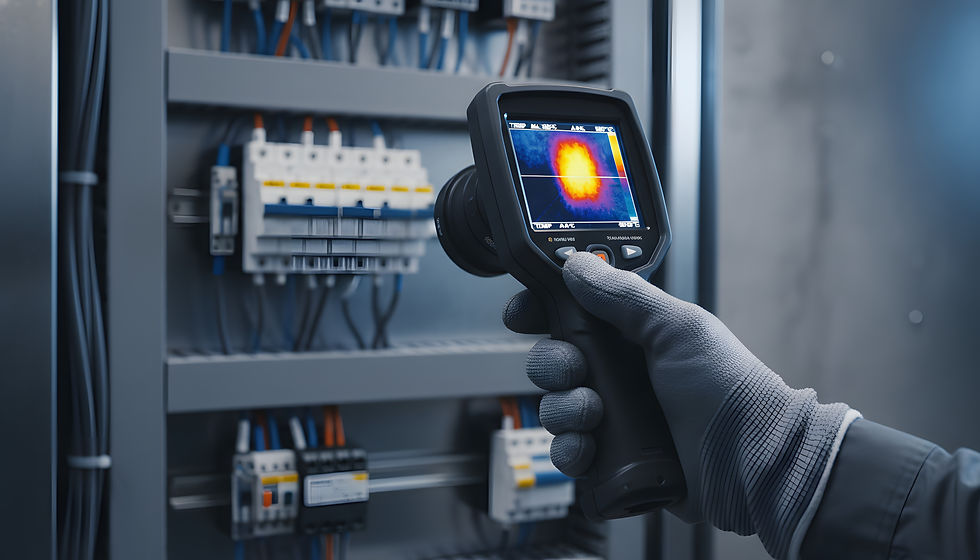
Electrical faults give off heat long before they fail, and a standard visual check cannot measure that heat through a closed panel cover. A thermal camera can. PECO uses FLIR infrared cameras to read the heat coming off your electrical and mechanical systems. The scan flags loose connections, overloaded circuits, and failing components that would go unnoticed during a routine check. Catching that heat early is what keeps a small fix from turning into an unplanned shutdown.

PECO scans the equipment most likely to overheat
A thermal inspection covers the parts of your building that carry the most current and take the most stress:
Electrical panels, breakers, and disconnects
Motors, control panels, and switchgear
Commercial and industrial electrical systems
Emergency lighting
Each scan produces a detailed report with annotated thermal images, notes, and recommended corrective actions. That report gives your maintenance team a clear list of what to fix and in what order, before a small hot spot becomes an outage.
Many insurers now require documented inspections
Insurance is driving a lot of this work. Many insurers now require documented inspections that prove a building's electrical systems meet safety standards, and PECO's reports are built to satisfy those requirements. They follow NFPA 70B guidelines and give your carrier the paper trail they want: dated thermal images, findings, and the corrective actions you took. For property managers running several buildings, that documentation also protects you if a claim is ever questioned. You can read more about PECO's insurance compliance inspections.
Most facilities schedule a scan once a year
Most commercial and industrial buildings benefit from an annual thermal scan. Some schedule more often when an insurer or an internal safety program calls for it. High-load and critical sites tend to be on the shorter cycle, because a single failure costs them the most: warehouses and industrial facilities, food processing and cold storage, labs, cleanrooms, and production spaces. If you manage properties like these, an annual scan is a small line item against the price of an unplanned shutdown. See how PECO supports property managers.

Book a scan before your next renewal
PECO works with building owners, facility teams, and insurers across Greater Boston, the North Shore, and Eastern Massachusetts. If your insurance renewal is coming up, or you just want to know what is running hot behind your panels, PECO's FLIR-certified thermographers can put it in a report you can act on.
Call PECO at (781) 938-6000 to schedule an infrared thermal imaging inspection.


